

Are you stepping into a grants management role for the first time, building a foundation from the ground up, or looking to overhaul an entrenched system? Whatever your situation may be, you should avoid a common pitfall: administrative processes hindering the very nonprofits you intend to help.
Grants management shouldn’t be a one-way compliance checklist. Too often, guidance focuses purely on how foundations can extract data from nonprofits, not on how to make it easy for them to partner with your foundation.
When you apply a trust-based design philosophy, you eliminate administrative hurdles, treat grantees as true partners, and drive more equitable outcomes. With this guide, your team can focus on meaningful relationships rather than endless paperwork and misaligned applications. Here’s what we’ll cover
As you explore these best practices, remember that Temelio’s modern grants management platform puts trust-based philanthropy into action by streamlining your entire workflow. Our purpose-built solution eliminates administrative friction, so your team can focus on what truly matters: maximizing your philanthropic impact.
The grant lifecycle encompasses the end-to-end journey of a funding program from the foundation's perspective. It typically begins with defining the mission and application guidelines, moves through the review and award selection phases, and concludes with post-award reporting and impact measurement.
Understanding this process is important for internal alignment and efficient execution. Here are the key stages to consider:
Treat this lifecycle as a circular feedback loop rather than a rigid sequence. Use the qualitative insights you gather during the final reporting phase to shape how you structure your program guidelines for the next grant cycle. Continuous refinement guarantees your grants management strategy evolves alongside actual community needs.
A foundation grants manager aims to balance legal compliance with strategic impact. Rather than simply moving applications through a pipeline, they architect the systems and experiences that define how the foundation interacts with the community. Their expertise ensures that the foundation's high-level visions translate into accessible, equitable processes for every applicant.
Here are some of the core responsibilities of a foundation grants manager:

A grants manager's true value lies in relationship-building and strategic problem-solving. When given the right operational framework, they can go beyond back-office administrative work to fuel community trust and organizational efficiency.
Effective grants management requires designing an intuitive experience for both your internal team and your applicants. With a thoughtful approach, your foundation can eliminate redundant forms, speed up your review process, and select grantees transparently without overburdening your staff. Let’s explore tips that will help you accomplish exactly that.
As mentioned, you’ll want to define the overarching goal your foundation wants to accomplish. This forms the basis for your entire funding cycle. Work with your team to articulate exactly what overarching change your organization hopes to achieve before accepting any proposals. Here are some examples to spark some inspiration:
Submitting a proposal shouldn’t feel like navigating a never-ending maze. Adopt a modern grantee portal where you can create straightforward forms and enable nonprofits to log in to check on their application status. Nonprofits should be able to:
By reducing the burden on grantees, your foundation demonstrates a genuine respect for their time. When nonprofit professionals don’t have to navigate clunky interfaces and repetitive typing, they can focus their energy on creating proposals that articulate their impact.
Bring varied perspectives into your evaluation process to drive better, more equitable outcomes. When review committees are made up solely of internal executives, it's easy to miss out on vital community context. By inviting local stakeholders and a wider array of staff members to evaluate proposals, you ensure your funds support initiatives that resonate with the people you’re trying to reach.
When defining your grants management process, set transparent expectations upfront to reduce applicant confusion and save everyone valuable time. Nonprofits need to see:
By publishing a highly visible scoring rubric alongside your application, you empower organizations to evaluate their own fit before they invest hours into drafting a proposal. Consider providing a rationale for the questions you’re asking, too. This gives grantees a clear sense of why each one is being asked and can provide richer and more accurate answers.
Whether you are promoting an open call or inviting specific organizations to apply, prove your foundation is a true partner through transparent communication. You might host open Q&A sessions, set up one-on-one kickoff calls, and provide clear contact details to establish immediate trust.
Take it a step further by allowing for two-way commenting on applications. If a nonprofit misses a minor detail, your team can simply ask them to upload the missing document or flesh out an answer directly within the portal—preventing an outright rejection over a simple misunderstanding.
Reviewing hundreds of dense narratives can lead to reviewer fatigue and delayed funding decisions. That's where AI can step in to streamline the review process. With Temelio’s native AI features and integrations, you can use AI summaries to gain quick insights into proposals and reduce the burden on your team.
As soon as a decision is made, use embedded communication tools to provide unified updates to applicants regarding their status. Transparent and respectful communication at this stage is a cornerstone of trust-based philanthropy.
For grantees, outline clear next steps, such as a timeline for when they need to sign grant agreements and when they can realistically expect the funds to hit their bank account. For declined applicants, share brief, actionable insights from your review team. Clearly explaining whether a rejection was due to limited funding, a slight misalignment in mission, or specific weak points in the proposal helps them improve for future cycles.
Processing delays can put unnecessary strain on a nonprofit's ability to run its community programs and pay its staff. Ensure you distribute funds efficiently by integrating your operational portal with standard core accounting tools. Grants management software like Temelio makes this possible! Seamless connection between your tools ensures that digital transfers process instantly and checks clear without complicated manual reconciliation, getting capital out the door faster.
Heavy compliance demands slow down actual progress. Simplify your back-end requirements, joining the 58% of funders who have reduced reporting burdens on nonprofits to save administrative time.
Focus strictly on requesting qualitative narratives and essential performance metrics that prove real-world impact. You might ask for metrics like:
Additionally, consider providing a brief grace period for reporting. This accounts for unexpected priorities or urgent community needs that rightfully demand a nonprofit's immediate attention over administrative tasks. It also proves your foundation prioritizes authentic partnerships.
Adopting intuitive grants management software empowers your team to streamline complex workflows and treat grantees as true partners. Temelio offers a modern, configurable platform built specifically for lean foundations seeking to maximize their philanthropic impact through frictionless collaboration. Our relationship-driven software transforms your daily operations from an administrative bottleneck into a strategic advantage.
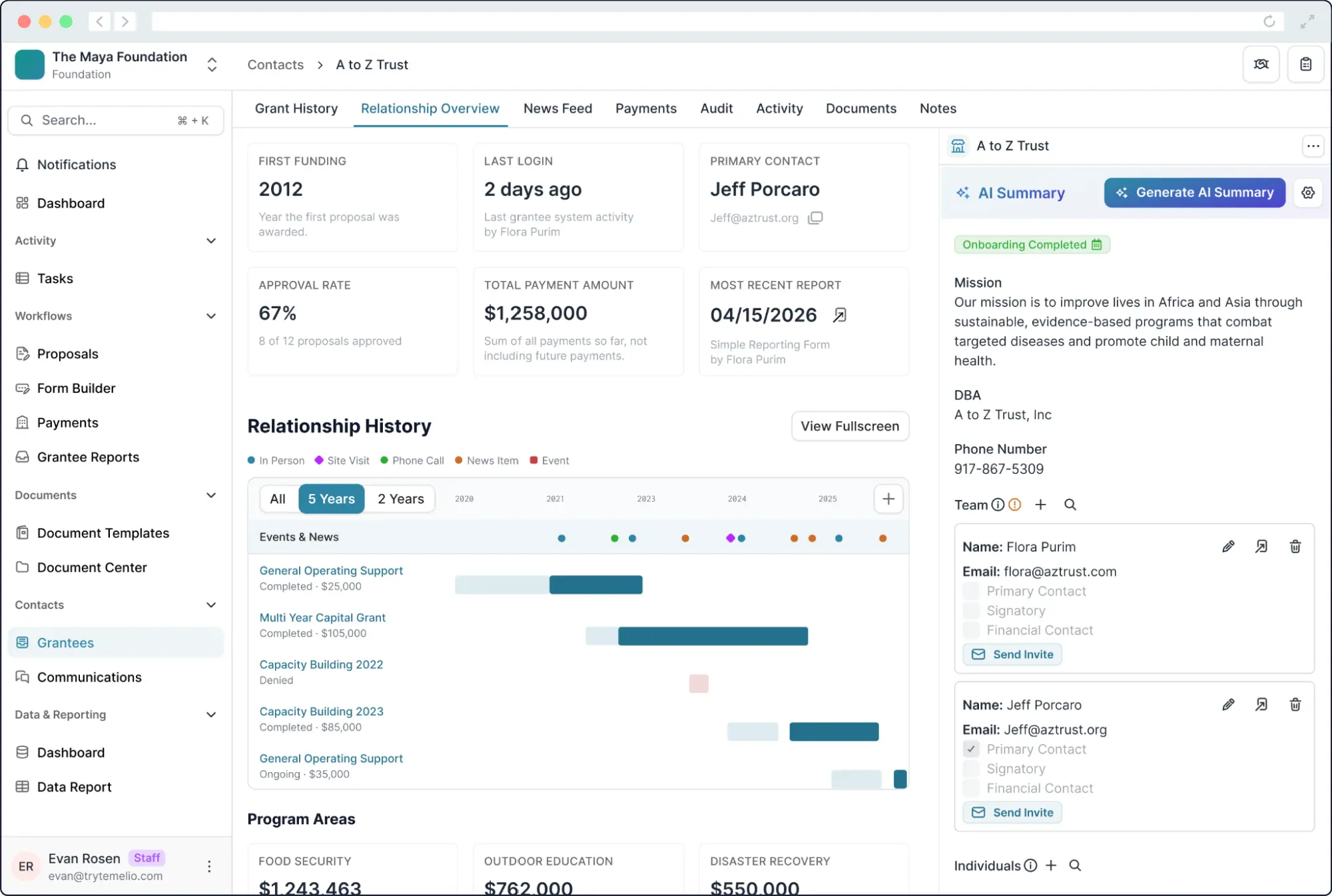
Tap into these key features designed to simplify grants management for foundations:
Curious how real foundations are creating more efficient operations and equitable grant opportunities with Temelio? Read about how the Find Your Light Foundation (FYLF) completely transformed its administrative workflows by adopting our modern grants intelligence software. (Spoiler: FYLF processed 3x more applications and was able to start awarding multi-year grants).

If you’re new to grants management, you likely have questions regarding funding types, operational roles, and platform selection. Below you’ll find answers to the most frequent inquiries foundation decision-makers have about modernizing their grantmaking process and software infrastructure.
A foundation grant is a financial award given to a nonprofit organization to support a specific programmatic initiative or general operating costs. Unlike loans, these funds never require repayment. Instead, foundations distribute them to advance a shared philanthropic mission and create real-world impact.
Grants management covers the entire lifecycle of distributing philanthropic funds, including designing the initial application, conducting due diligence, disbursing funds, and reviewing impact reports. It requires balancing necessary financial compliance with robust grantee support. When executed correctly, grants management minimizes administrative friction and maximizes community impact.
Compared to rigid government grants, foundation grants offer key advantages: simpler applications, faster decision-making, and adaptable funding structures like multi-year or unrestricted general operating support. Because foundations set their own guidelines, they can respond to community needs without excessive red tape.
The ideal platform depends on your team's specific size and functional requirements. The best grants management software functions as a collaborative hub rather than a static filing cabinet. Platforms like Temelio eliminate redundant data entry, centralize team communication, and integrate seamlessly with core accounting tools, so your team can spend less time on paperwork and more time building relationships.
Optimizing your foundation’s grants management lifecycle requires continuous learning and operational refinement. Start by auditing your current application requirements to identify any unnecessary administrative roadblocks holding your applicants back. And if you haven’t already, invest in grants management software that’s built specifically for foundations like yours.
To further support your grantmaking, explore these free resources:
Maya Kuppermann is the Co-Founder and CEO of Temelio, a modern grants management platform built for small and mid-sized foundations and philanthropic organizations. With experience spanning nonprofit leadership, family philanthropy, and technology, Maya brings a practitioner’s perspective to building software that simplifies and strengthens grantmaking. She has worked closely with over one hundred funders to modernize their operations and improve the grantee experience. Maya is passionate about leveraging technology to increase the effectiveness and accessibility of philanthropy.

Working with you globally from NYC
14 Wall St, 18C New York, NY 10005