

The conversation around AI in philanthropy has shifted over time. Foundations are no longer asking if they should use artificial intelligence. Instead, they’re asking where it can add the most ethical and operational value.
While early buzz focused on whether algorithms would one day make funding decisions, the reality of AI in grantmaking is much more practical. Today, modern grants management software uses AI to streamline funder workflows and address one of philanthropy’s oldest challenges: the administrative burden on grantees.
In this guide, we'll explore the real-world applications, risks, and solutions for integrating AI into your grant cycle. Here’s what we’ll cover:
Platforms like Temelio are leading this shift by infusing purpose-built AI directly into the grant management lifecycle. By eliminating repetitive data entry for applicants while delivering instant portfolio intelligence to staff, Temelio enables funders like you to improve outcomes, save time, and deepen trust-based relationships.

For foundation staff, AI acts as a co-pilot, surfacing insights and handling the tedious administrative work that often bogs down the grant cycle. Grantmakers also use it to make it easier for nonprofits to apply for opportunities. Here is how forward-thinking funders are leveraging AI today:
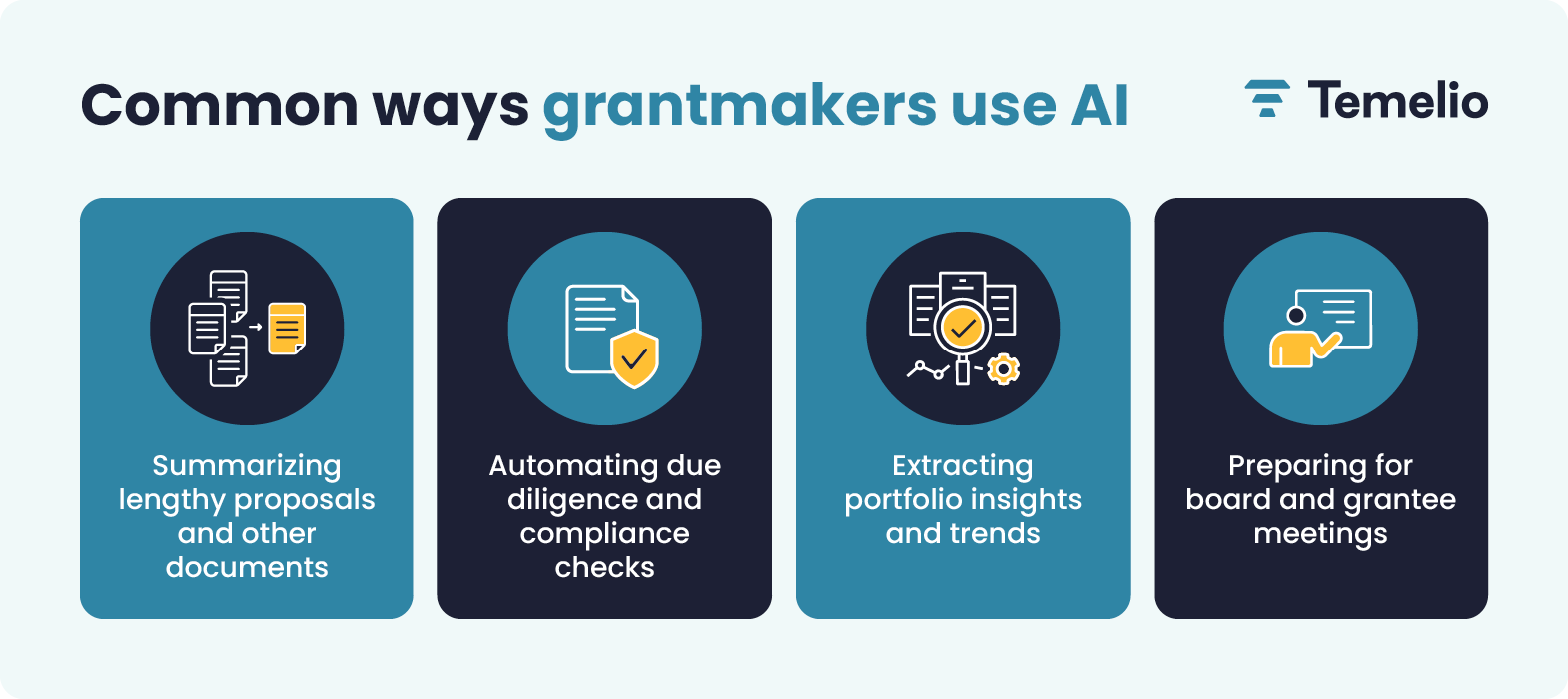
Program officers spend countless hours reading lengthy narrative proposals, financial audits, and annual impact reports. AI tools within your grants management software can instantly synthesize these documents into concise, objective executive summaries alongside historical applicant context. This makes it easier for staff and board members to digest complex grant applications without forgetting historical relationships.
For your review committee, AI can perform a comprehensive check on an organization's overall health. Rather than manually parsing tax filings and financial audits, grantmakers use AI to automatically evaluate factors such as:
Conducting due diligence ultimately protects your foundation’s reputation, ensuring you’re only funding organizations that have proper tax-exempt status, operate with financial integrity, and deliver meaningful impact in their communities.
Extracting insights from legacy grant databases used to require complex, manual reporting. Now, with Temelio’s MCP connector, your staff can use your preferred AI assistant (Claude or ChatGPT) to query grantmaking data while keeping sensitive information protected. By asking straightforward questions like, "What were our top funding areas last year?" or "Show me the funding history for this organization," your team can instantly generate charts, spot portfolio trends, and make data-driven decisions.
Preparing for a site visit or board meeting typically involves hunting down fragmented information across emails, payment logs, and scattered notes. Temelio solves this through its automated grantee history summary. Powered by AI, it automatically aggregates an organization's entire background (including past awards, recent communications, payment statuses, and relevant news coverage) into a single, comprehensive briefing on their CRM profile. This way, staff can walk into any check-in fully prepared.
While boosting your foundation’s efficiency is important, AI can also transform the grantee experience.
Nonprofits are already pressed for time and resources. When applying for grants, they shouldn’t have to re-enter information they previously submitted to your organization. Examples include their mission statement, organizational history, demographic metrics, financial information, and previous awards.
To cope with these slowdowns, many nonprofits have turned to external generative AI tools to draft proposals. While this speeds up submission, nonprofits’ reliance on tools that aren’t purpose-built for grant proposals creates a new issue for funders: an influx of generic narrative responses that obscure an applicant’s real-world impact and make evaluation harder.
The solution isn't for applicants to use third-party bots to generate fluff. Instead, grantmakers should implement native, purpose-built AI inside their intake portals.
When you choose grants intelligence software that offers AI tools, you solve this problem at its root through intelligent data recycling. Built-in AI assistants can make suggestions based on uploaded documents, past applications, and a grantee’s profile. Grantees simply review, refine, and submit.
This approach delivers a clear win-win: nonprofits save time while retaining their authentic voice, and funders receive higher-quality data.
If your foundation has concerns about leveraging AI in grantmaking, you’re not alone! It’s best to understand common risks, so you can deploy purpose-built technology and AI policies to combat them.
Some risks of AI in the philanthropic sector include:
Responsible AI adoption is all about choosing the right technology and directing it thoughtfully. To navigate the above challenges, try these foundation practices:
If your foundation is looking to replace a legacy system or integrate AI into its workflow, you need a platform that balances funder efficiency with a grantee-first design. Key criteria to look for include native AI capabilities, bank-grade security, robust reporting, and a centralized CRM.
Temelio is modern grants intelligence software designed to streamline the entire grant lifecycle while keeping relationships at the center of your grantmaking.
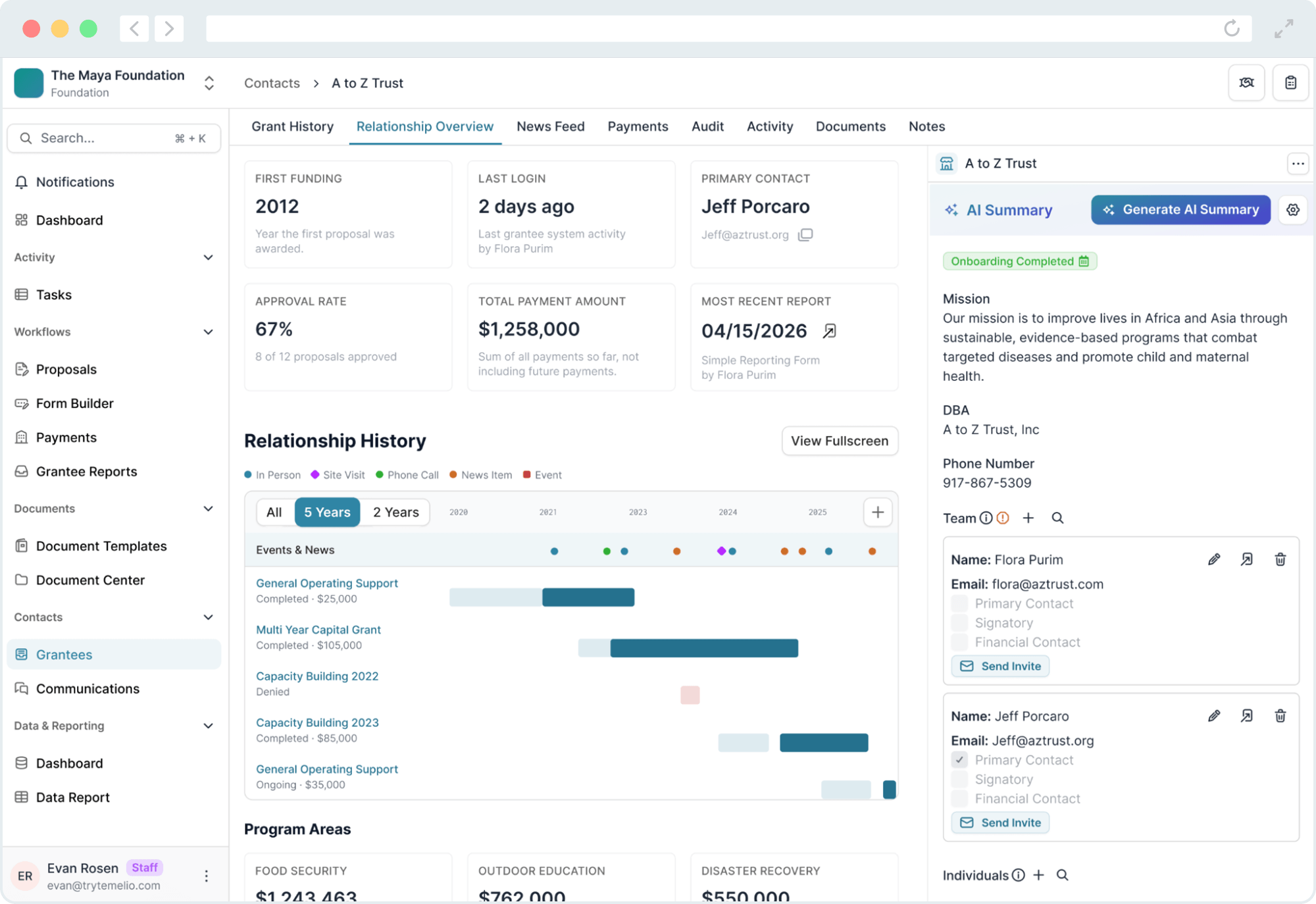
Temelio's core AI features include:
All of these features combined result in smarter, quicker decision-making and a better grantee experience. Check out the short video below for a demo of how Temelio’s AI Assistant saves time for your grant applicants:
By bringing these intelligent features directly into your foundation’s workflow, Temelio transforms your grant process from an administrative chore into a strategic driver of impact. Experience how easy it can be to lighten the load on your grantees while empowering your team with real-time portfolio intelligence.
The future of AI in philanthropy is all about removing administrative friction so funding reaches impact faster. By leveraging AI in your grantmaking, you can improve the grantee experience, accelerate review cycles, and spend more time building the meaningful, trust-based relationships that drive real change.
To continue refining your grantmaking efforts, explore these resources:

Maya Kuppermann is the Co-Founder and CEO of Temelio, a modern grants management platform built for small and mid-sized foundations and philanthropic organizations. With experience spanning nonprofit leadership, family philanthropy, and technology, Maya brings a practitioner’s perspective to building software that simplifies and strengthens grantmaking. She has worked closely with over one hundred funders to modernize their operations and improve the grantee experience. Maya is passionate about leveraging technology to increase the effectiveness and accessibility of philanthropy.

Working with you globally from NYC
14 Wall St, 18C New York, NY 10005