

It’s easy for your foundation to accidentally build a grantmaking process that works perfectly for your internal team but creates headaches for applicants. But true partnership means putting the grantee experience front and center. When you intentionally reduce administrative hurdles and simplify workflows, you give nonprofits their valuable time back to focus on what really matters: their missions.
In this guide, we'll break down the core parts of the applicant journey and show you how the right technology can make a world of difference. Here’s what we’ll cover:
Whether you're tweaking a few forms or looking for brand new grants management software to redesign the grantee experience, even small changes can make a massive difference for the nonprofits you support. Keep reading to find actionable tips on how to build a better process and maximize your philanthropic impact.
The grantee experience encompasses every touchpoint and interaction a nonprofit organization has with a funder throughout the entire grant lifecycle. Think of it as the philanthropic equivalent of the user journey. While many foundations immediately picture the grant application itself, the true grantee experience is actually much broader.
It begins the moment a nonprofit first researches your foundation's guidelines and extends through the pre-proposal phase, the application, due diligence, award notification, and post-grant reporting. From navigating your foundation's website to logging into a grantee portal and communicating with program officers, every single step shapes how a grantee perceives their relationship with your organization.
To be a true partner to nonprofits, your foundation should prioritize creating a positive experience. Optimizing the grantee experience isn’t just a nice-to-have checkbox. Rather, it’s a crucial part of maximizing your philanthropic impact. Here’s why getting it right is so important:
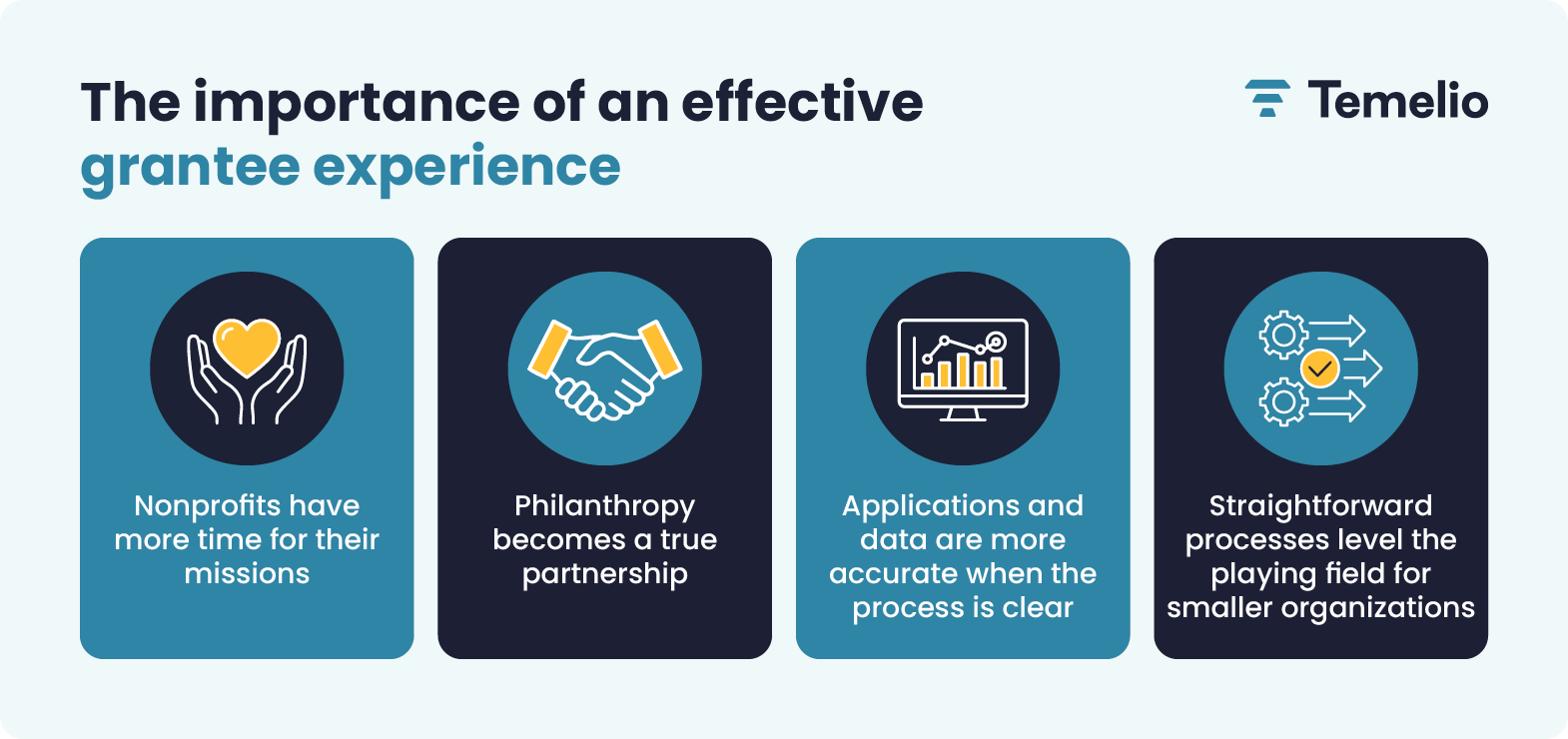
At the end of the day, your grantmaking process should be a bridge to impact, not a barrier. By putting yourself in your grantees' shoes and designing an experience with their needs in mind, you empower the people and causes you care about most.
Because the grantee experience spans the entire grant lifecycle, it helps to break it down into manageable phases. When we look closely at how foundations like yours interact with nonprofits, the overall experience is typically built on four core pillars: pre-award/application, communication, post-award, and capacity building.
Getting each of these right is the key to a healthy, balanced funder-grantee relationship.
This is often the most time-consuming phase for nonprofits, and it sets the tone for the entire relationship. The pre-award experience starts the moment a nonprofit looks at your website. Are your funding priorities and eligibility requirements clear, or do they leave applicants guessing? Do you share examples of winning proposals and grantees, so applicants understand what you’re looking for?
Once they decide to apply, the application itself takes center stage. The median time nonprofits spend on a grant proposal is 15 hours, so do anything you can to cut down your requests here.
A positive application experience means matching the length and complexity of your forms to the size of the grant. It means only asking for the information you actually need to make a decision, ensuring instructions are clear, and avoiding redundant questions. When the application process is streamlined, grantees feel respected right out of the gate.
For a nonprofit, few things are more stressful than hitting "submit" and waiting in silence. Communication is the thread that holds the grantee experience together. This pillar covers:
Good communication is proactive and transparent. It means setting clear expectations for when applicants will hear back from you and providing constructive feedback when possible—even if it's a "no." By prioritizing real human connections, grantees feel seen and valued as partners rather than just applications in a queue.
The grantee experience doesn't end when the money is deposited in the nonprofit’s bank account. In fact, this is when the actual work begins! Historically, post-award reporting has felt like a homework assignment for nonprofits—a strict compliance exercise rather than an opportunity for shared learning.
A strong post-award experience shifts this dynamic. It involves aligning your reporting requirements with the size and scope of the grant so you aren't asking for a 10-page impact report on a $5,000 community grant. It also means actively listening to their updates, celebrating their wins, and being flexible when projects need to pivot.
The best funder-grantee relationships go beyond the check. Capacity building is about how you support the overall health and sustainability of the organizations you fund.
This can take many forms depending on your foundation's resources. It might mean:
When you invest in a grantee's capacity, you prove that you’re invested in their long-term success, not just their short-term project outcomes.
When it comes to product design, sometimes the smallest features can make the biggest difference. Let’s explore some of Temelio’s product features that have made a big difference in helping the funders on our platform improve the grantee experience. These features came from two challenges that our team heard loud and clear from funders and grantees:
While a product cannot solve these challenges entirely, there are countless things technology can do to help improve the grantee experience.
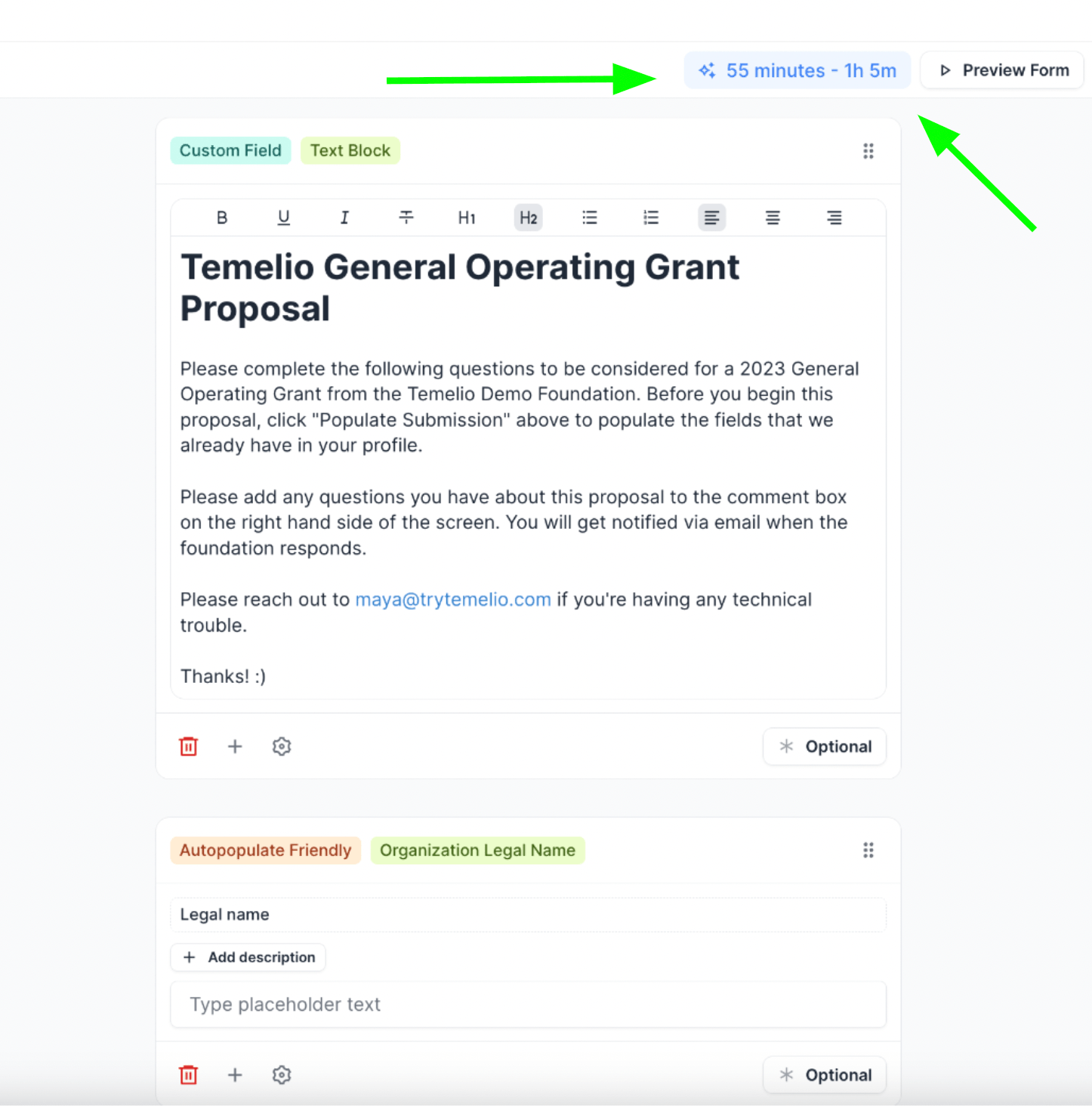
When a grantmaker builds a form in our platform, they see an AI-enabled time estimate to provide visibility into how long it will take a grantee to complete their form (screenshot below). This allows funders to accurately understand the time requirement of the information they are collecting and make adjustments.
Many grantees often find themselves filling out similar information across different grant proposals, which can be time-consuming. Temelio leverages AI to enhance the grantee experience by offering the following core features to nonprofits:
Check out this video where our founder, Maya Kuppermann runs through the AI capabilities for your applicants:
Learn more about our approach to AI and how it improves the entire process in our blog post about AI in grantmaking.
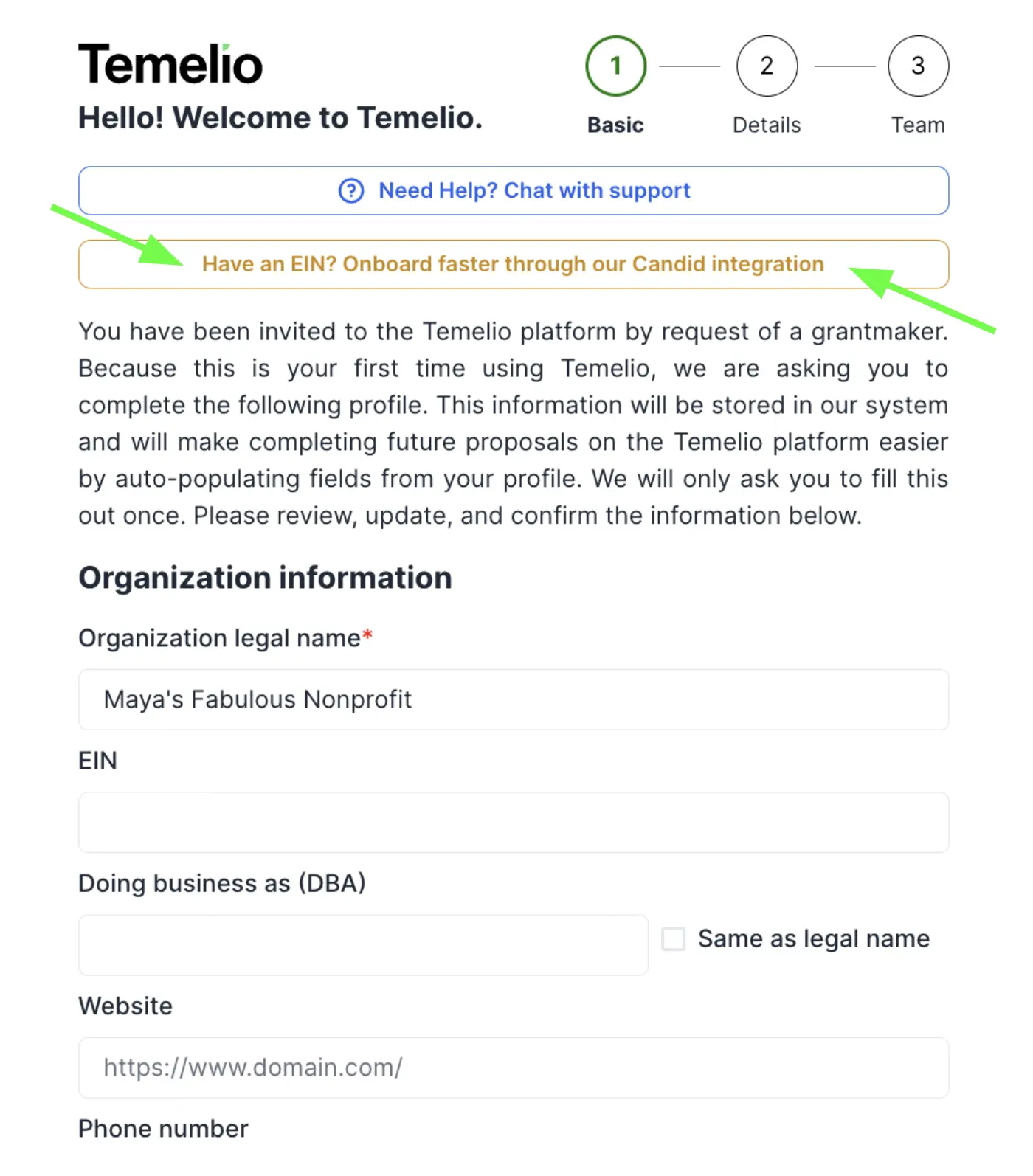
To help grantees further avoid filling out the same information time and time again for funders, Temelio built an integration with Candid to allow grantees to populate all organization profile fields, pulling verified information directly from their Candid profile. When grantees onboard the Temelio platform, they are prompted to “Onboard faster through our Candid integration.”
Beyond this, Temelio centralized our grantee portal, so fields populated in previous applications will always auto populate in all future applications (including Candid fields). In the meantime, any information is conveniently stored in each organization’s centralized profile within your foundation’s CRM.
During the review process, your team will inevitably need to ask a grantee for more information, a quick clarification, or a supplementary document. Historically, this meant sending a separate email, which often forced the grantee to dig back through their application just to figure out exactly what context you were referring to.
To keep communication seamless, Temelio includes built-in commenting directly within the platform. Your team can leave comments or request additional details right on the specific proposal or field in question. This makes life infinitely easier for your grantees. They receive a clear, contextualized request and can upload the exact document or provide the answer you need without trying to decode a confusing email thread.
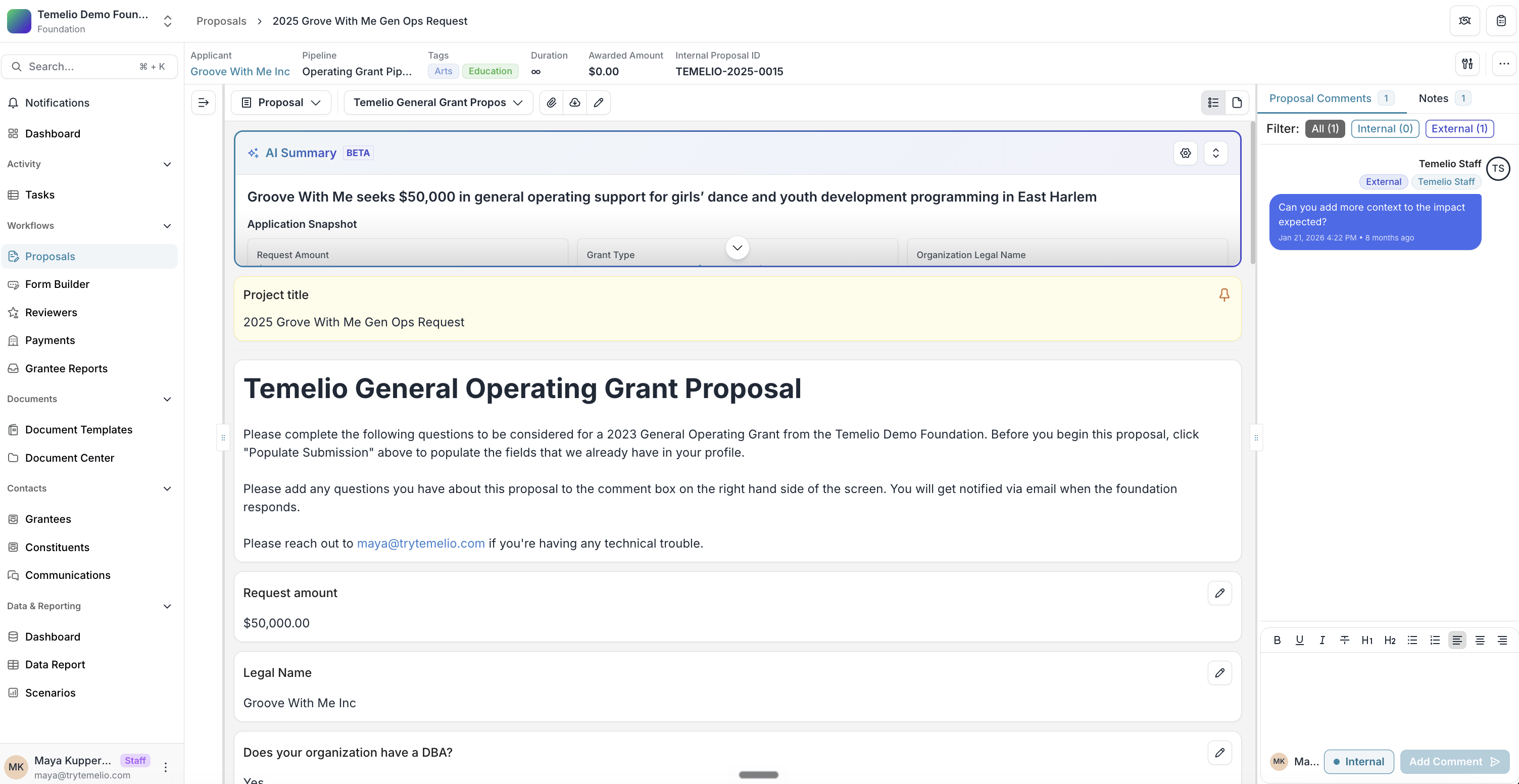
Beyond this, Temelio centralized our grantee portal, so fields populated in previous applications will always auto populate in all future applications (including Candid fields). In the meantime, any information is conveniently stored in each organization’s centralized profile within your foundation’s CRM.
To further support nonprofit teams, Temelio offers collaborative editing. Historically, coordinating a grant proposal across multiple team members could lead to version control issues and duplicated efforts. Now, grantees can work on forms at the exact same time and see each other's updates and changes in real-time—similar to working in a Google Doc.
This shared workspace gives nonprofits better visibility and coordination within their own teams. You’ll help streamline the application process so they can get back to focusing on their missions.
Building a better grantee experience is all about stepping into your applicants' shoes and looking at your process from their point of view. By focusing on straightforward applications, open communication, and real capacity building, you can form true partnerships.
The right technology (like Temelio) can do a lot of the heavy lifting here, such as using tools like AI and automatic profile updates to instantly take the burden off your grantees. At the end of the day, when you make the process easier for your nonprofit partners, you empower them to do more of the work that matters most.
As you start improving your grantee experience, explore these free resources:
Maya Kuppermann is the Co-Founder and CEO of Temelio, a modern grants management platform built for small and mid-sized foundations and philanthropic organizations. With experience spanning nonprofit leadership, family philanthropy, and technology, Maya brings a practitioner’s perspective to building software that simplifies and strengthens grantmaking. She has worked closely with over one hundred funders to modernize their operations and improve the grantee experience. Maya is passionate about leveraging technology to increase the effectiveness and accessibility of philanthropy.

Working with you globally from NYC
14 Wall St, 18C New York, NY 10005